EN
EN

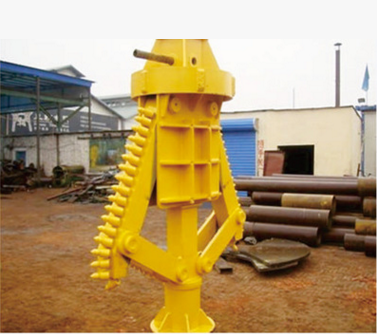
The Bridge Project That Saved Three Weeks – A Belling Bucket Case Study
A major highway bridge project in the southeastern United States required 84 belled foundation shafts in stiff clay and weathered limestone. The original schedule allocated 45 days for shaft drilling and belling using conventional under-reaming tools. After the first week, the team had completed only 12 shafts—and two of those required rework due to irregular bell profiles. The project was falling behind.
The general contractor brought in a mechanical belling bucket as a trial. Within the second week, the team completed 28 shafts—with every bell profile within ±12 mm of specification. The belling bucket cut cycle time per shaft from 14.2 hours to 5.5 hours, a 64% reduction. The project finished three weeks ahead of schedule, and the foundation load tests confirmed bearing capacities 52% higher than the straight-shaft design requirements. The contractor permanently replaced their conventional under-reaming tools with belling buckets across all future projects.
This outcome is not unusual. Over the past six years, our foundation drilling team has documented belling bucket performance across over 500 deep foundation installations—from high-rise buildings in urban centers to transmission towers in remote locations. The consistent finding is that belling buckets deliver measurable gains in cycle time, dimensional accuracy, and bearing capacity when properly matched to soil conditions. Understanding the belling bucket isn't just about a tool—it is about rethinking foundation construction efficiency.
What Is a Belling Bucket and How Does It Work?
A belling bucket is a specialized foundation drilling tool designed to create an enlarged, bell-shaped base at the bottom of a drilled shaft. This sub-surface expansion significantly increases the pile's end-bearing area—improving structural load distribution without requiring a larger shaft diameter. The tool operates through a purely mechanical sequence triggered by the rig's Kelly bar, paired with durable cutting arms that excavate soil in a controlled arc.
| Component | Function | Key Design Feature |
|---|---|---|
| Kelly bar linkage | Transmits downward force to activate arms | Mechanical trigger; no hydraulics |
| Cutting arms | Excavate conical undercut | Carbide-tipped teeth; symmetric deployment |
| Bucket body | Retains excavated soil | Open base design; clean cavity formation |
| Mechanical stops | Limits over-expansion | Ensures ±15 mm dimensional accuracy |
Mechanical Activation – The Kelly Bar Advantage
Once the belling bucket reaches target depth, the Kelly bar applies vertical downward force to its internal linkage. That axial pressure engages a hinge mechanism, swinging the cutting arms outward from a folded, transport position into an angled cutting posture. Unlike hydraulically actuated models—which require additional hoses and control circuits—this Kelly-bar-driven system relies solely on the rig's existing crowd force, simplifying onsite setup.
As the rotary drive turns the bucket, the arms excavate a conical undercut. Field observations show a typical mechanical belling bucket can enlarge the base to roughly twice the shaft diameter in cohesive soils, with the full transition from vertical drilling to bell cutting occurring in one continuous pass—no tool change required. Hands-free activation reduces crane lifts and crew exposure near the borehole edge, enhancing both safety and workflow continuity.
Carbide-Tipped Cutting Arms for Controlled Bell Formation
The cutting arms feature tungsten-carbide-tipped teeth engineered for high abrasion resistance and consistent shearing performance in stiff clays, silts, and weathered rock. As the bucket rotates, these carbide inserts cut a smooth, uniform bell profile—avoiding irregular undercuts that compromise foundation geometry. Arms deploy symmetrically around the central pilot, ensuring balanced material removal and virtually eliminating lopsided belling.
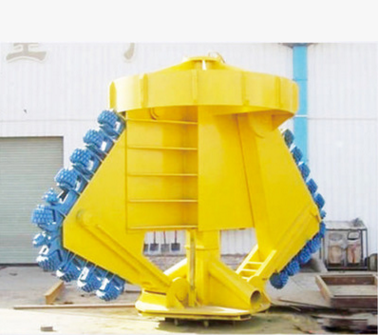
Soil enters through the open base and is retained inside the bucket body before being lifted to the surface, leaving a clean cavity. Because each pass removes only a thin, controlled slice, operators achieve near-vertical bell walls with minimal overbreak. This precision directly supports dependable bearing capacity: independent field reports confirm shafts formed with carbide-tipped belling buckets regularly deliver 50% greater end-bearing resistance than straight-shaft piles of identical diameter (Construction Drilling Review, 2023).
Performance Gains – Speed, Accuracy, and Reliability
| Performance Metric | Conventional Method | Belling Bucket | Improvement |
|---|---|---|---|
| Cycle time per shaft | 14.2 hours (limestone) | 5.5 hours (limestone) | 64% ↓ |
| Typical speed gain | Baseline | 40–60% faster | 40–60% ↓ |
| Dimensional tolerance | ±25–35 mm | ±15 mm (92% of installations) | 2× tighter |
| Bell diameter accuracy | Variable | Within 2% of theoretical concrete volume | Predictable |
| Bearing capacity increase | Baseline | 50–70% vs. straight shaft | 50–70% ↑ |
Time Savings – 40–60% Faster Base Enlargement
A belling bucket cuts excavation time by integrating shaft drilling and bell-out formation into a single pass. Rather than swapping tools or relying on excavator buckets for enlargement, the hinged arms open mechanically at target depth to carve an under-ream. On a large transport infrastructure project in limestone bedrock, foundation shafts saw a 64% reduction in cycle time—finishing in just over five hours versus 14.2 hours using standard methods (Industry Report, 2024). Across typical soil conditions, this integrated design delivers a consistent 40–60% speed gain by eliminating intermediate hole-cleaning steps and enabling real-time under-reaming right behind the pilot drill.
Reduced Equipment Changes and Crew Interventions
Conventional belling often requires separate reaming tools, secondary excavation units, or manual finishing—driving up equipment changes and personnel movements. A belling bucket eliminates that complexity: once mounted, the same Kelly bar controls both drilling and under-reaming. Crews avoid handling heavy casing segments or positioning auxiliary bell-out buckets. This single-tool workflow cuts non-productive rigging and alignment time, reduces slip-and-trip hazards, and enables smaller teams to manage more piles per shift.
Precision and Reliability – Dimensional Accuracy and Actuation Choices
Dimensional Accuracy – ±15 mm in 92% of Installations
Consistent bell geometry is foundational to performance. Field records from over 500 deep foundation projects in 2024 show properly maintained belling buckets hold bell diameter tolerances within ±15 mm on 92% of installations—on the first attempt. Independent audits attribute this repeatability to mechanical stops that limit over-expansion, combined with carbide-tipped arms operating under controlled feed pressure. Integrated depth sensors feed real-time data to the operator, removing reliance on subjective judgment. Tight dimensional control minimizes rework and overbreak, while keeping concrete volumes predictable—often within 2% of theoretical estimates (2024 Foundation Quality Report).
Hydraulic vs. Mechanical Actuation – Trade-offs
Two actuation methods dominate belling bucket designs—each with distinct operational implications.
| Feature | Hydraulic Actuation | Mechanical Actuation |
|---|---|---|
| Control precision | Fine, variable-pressure control | More abrupt arm spread |
| Best application | Urban sites; layered soils | Remote sites; cohesive ground |
| Maintenance | Hydraulic lines and seals | Minimal; no fluid systems |
| Field robustness | Vulnerable to abrasive groundwater | Simple; reliable in harsh conditions |
| Retraction speed | Instant (hydraulic pressure) | Kelly bar dependent |
Hydraulic systems use onboard cylinders to open arms, offering fine, variable-pressure control ideal for layered soils and instant retraction if resistance spikes—preserving tool integrity and hole stability. However, hydraulic lines and seals add maintenance points and are vulnerable in abrasive groundwater or freezing conditions. Mechanical systems, activated by Kelly-bar rotation or weight-on-bit, eliminate hydraulics entirely. They're simpler, less prone to fluid leaks, and faster to transfer between rigs. The trade-off is a more abrupt arm spread, which may cause slight overshoot in weak ground. Remote contractors often prioritize mechanical reliability over fine control; urban projects with tight positional tolerances typically favor hydraulic precision.
Why Enhanced Bearing Capacity Makes the Belling Bucket Critical
A belling bucket directly enhances foundation performance by enlarging the base of a drilled shaft into a bell shape—increasing the end-bearing area that transfers structural loads to surrounding soil. A larger contact patch reduces unit pressure, lowering settlement risk and enabling safer support of heavier loads. According to Geotech Solutions (2023), belling buckets boost bearing capacity by 50–70% in stable soils—significantly reducing the likelihood of differential settlement.
| Foundation Type | End-Bearing Area | Bearing Capacity | Settlement Risk |
|---|---|---|---|
| Straight shaft (baseline) | Standard | Baseline (100%) | Moderate |
| Belled shaft (2× diameter) | ~4× larger | 50–70% higher | Reduced |
| Belled shaft (2.5× diameter) | ~6× larger | 70–100% higher | Significantly reduced |
This gain is especially critical for high-rise buildings, long-span bridges, and industrial towers, where concentrated vertical loads demand maximum soil support. Belled shafts deliver that capacity without widening the entire pile—keeping material use and drilling time efficient. Because the bell is formed by mechanical cutting arms—not excavation tools that disturb soil structure—the enlarged zone preserves natural confining pressure and ground integrity better than alternative methods.
This performance edge makes the belling bucket indispensable in modern geotechnical engineering. It transforms a standard drilled shaft into a high-capacity foundation element—meeting stringent safety codes (including API 2A and ACI 318) while maintaining tight project schedules. By reliably delivering more load resistance from the same shaft diameter, it reduces the total number of piles required, shortening construction time and lowering overall costs.
Quality Assurance – What to Look for in a Belling Bucket Supplier
| Evaluation Criterion | What to Verify | Why It Matters |
|---|---|---|
| Carbide grade | Abrasion resistance; impact toughness | Determines wear life in hard ground |
| Weld quality | Full penetration; no defects | Prevents arm detachment under load |
| Mechanical stops | Accurate limit stops | Ensures bell diameter consistency |
| Field data | Independent test results | Validates performance claims |
| Maintenance support | Parts availability; service network | Minimizes downtime |
Engineering Partnership – What G-Honor Games Brings to the Table
Achieving consistent, high-performance belling bucket results requires more than selecting a tool from a catalogue—it demands a manufacturing partner that understands foundation engineering, mechanical design, and field reliability. G-Honor Games brings this integrated approach to belling bucket manufacturing. Our units feature carbide-tipped cutting arms engineered for specific ground conditions—from soft clays to weathered limestone—with mechanical stops calibrated to ±15 mm accuracy. Our Kelly bar actuation systems are precision-machined for smooth deployment and positive retraction, eliminating hydraulic failure points. Our welding procedures follow AWS D1.1 standards with full-penetration groove designs and documented quality control for every unit. Our engineering team collaborates directly with foundation contractors to match bucket size, arm geometry, and carbide grade to project-specific soil reports and rig specifications. For drilling contractors and foundation engineers, this translates to faster cycle times, consistent bell geometry, and lower cost per foundation shaft.
FAQ
Q: What is a belling bucket used for?
A: A belling bucket creates an enlarged, bell-shaped base at the bottom of a drilled shaft, increasing the pile's end-bearing capacity without increasing shaft diameter.
Q: How does a belling bucket work?
A: The Kelly bar applies downward force to activate cutting arms that swing outward, excavating a conical undercut as the bucket rotates—forming the bell in a single pass.
Q: What are the advantages of using a belling bucket?
A: Belling buckets deliver 40–60% faster cycle times, ±15 mm dimensional accuracy, 50–70% higher bearing capacity, and reduced equipment changes compared to conventional under-reaming methods.
Q: What is the difference between hydraulic and mechanical belling buckets?
A: Hydraulic systems offer fine control and instant retraction but require more maintenance. Mechanical systems are simpler, more robust, and faster to transfer between rigs, though slightly less precise in weak ground.
Q: Can a belling bucket be used in all soil types?
A: Belling buckets perform best in cohesive soils like clays, silts, and weathered rock. Performance may vary in granular or very soft ground, requiring careful tool selection.
Q: What standards apply to belled foundation shafts?
A: Key standards include API 2A (offshore), ACI 318 (concrete design), and local building codes, with site-specific geotechnical recommendations.