EN
EN

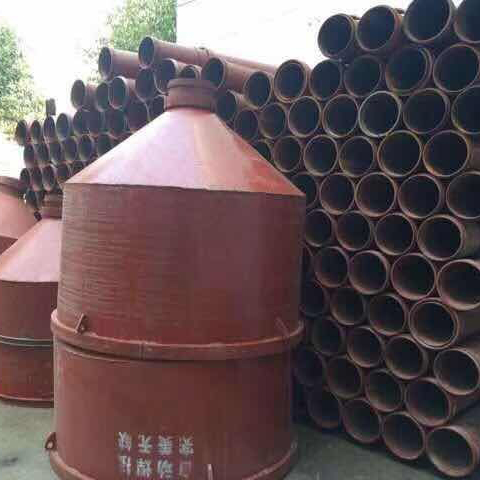
Drilling in saturated, unconsolidated sand presents unique challenges. Without precise casing pipe design, hydrostatic pressure and lateral earth forces can lead to rapid borehole collapse. This guide explores the engineering requirements for maintaining structural integrity in compressible strata.
1. The Mechanics of Borehole Failure
When groundwater saturates loose sand, intergranular suction vanishes, removing the soil's temporary cohesion. The formation loses structural integrity, leading to:
Dynamic Particle Flow: Unimpeded movement of sand grains.
Hydraulic Uplift: Excessive pore water pressure acting radially on the borehole wall.
Static Liquefaction: Sudden stress redistribution resulting in rapid collapse.
2. Calculating Casing Thickness (API & ISO Standards)
External collapse pressure is the governing design load, not tensile strength. We utilize API RP 5C3 and ISO 10400 to define collapse regimes (yield, plastic, transition, and elastic).
The Calculation Framework
| Step | Parameter | Calculation Method |
| 1 | Groundwater Pressure ($P_w$) | $\gamma_w \cdot h_w$ |
| 2 | Lateral Earth Pressure ($P_s$) | $K_0 \cdot \gamma' \cdot H$ |
| 3 | Total External Pressure ($P_{ext}$) | $P_w + P_s$ |
| 4 | Required Resistance | $P_{collapse} \geq 1.5 \cdot P_{ext}$ |
At depths $\geq 15$ m, a minimum wall thickness of 6–8 mm is typically required to withstand lateral loads exceeding 4.5 kN/m.
3. Buckling: The Critical Failure Mode
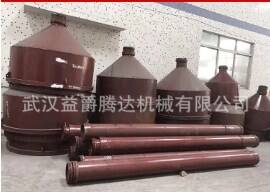
In loose sand, casing failure is overwhelmingly driven by buckling under non-uniform lateral pressure, rather than tensile yield. Asymmetric loads from groundwater fluctuations and differential settlement can initiate ring-mode folding long before material yield limits are reached. Prioritizing buckling analysis is essential for maintaining well integrity.
4. Matching Stiffness to Soil Gradation
Casing selection must be based on soil gradation parameters:
$D_{10}$: Indicates grain fineness; lower values require higher casing rigidity.
$C_u$: Uniformity coefficient ($<2$) indicates sands prone to sudden rearrangement.
Relative Density: High-density sands ($\geq 75\%$) allow partial load transfer, demanding precise interface friction modeling.
FAQ
Why does loose sand require precise design?
It loses structural integrity when saturated, leading to rapid borehole collapse. Proper casing confines the formation against particle flow and liquefaction.
Why is buckling more critical than yield strength?
Non-uniform lateral pressures in unconsolidated sands make casing vulnerable to structural deformation and buckling well before the material reaches its tensile yield point.
Ready to Optimize Your Drilling Project?
Do you need a custom load analysis for a complex geological stratum?
[Contact Our Engineering Team] for a professional consultation.
[Download Our API 5CT Compliance Checklist] to ensure your project meets safety standards.